Þingvellir or Reykjanes? Where Reykjavík aurora tours drive
No northern lights tour from Reykjavík follows a set route. The guide checks the cloud forecast in the evening and drives toward whichever patch of sky looks clearest. These are the directions the drivers head most often, and the one tour that starts somewhere fixed.
Why the minibuses leave the city first
Reykjavík is a small capital whose streetlights and harbor still throw a glow into the sky. That glow is enough to hide a faint aurora, which looks pale grey to the eye long before a camera shows it green.
So every tour on our list drives out of town before anyone gets out to look. The aim is darkness first and a gap in the cloud second, since light pollution fades quickly once the suburbs are behind you.
The lights themselves glow high above the ground, and Iceland sits under the auroral oval. You rarely need to travel far to be under them. What the guides travel for is clear air.
No listing names a viewing spot
None of our three listings names a place for the aurora part of the night. That is deliberate, because Icelandic weather shifts within hours and a fixed stop would be cloudy on many evenings.
The guide reads the cloud-cover forecast and picks a direction, then changes it on the way if the sky closes in. One night that means a short hop out of town; another night the drive takes much longer.
Treat any spot below as a likely direction, not a promise. The northern lights are never guaranteed anywhere, and the free retries described in our guide to cloudy nights exist because some evenings stay grey wherever you go.
East toward Þingvellir National Park
Drivers often head east toward Þingvellir, the national park where Iceland's old parliament met in the open air. The road climbs away from the coast, and inland valleys are sometimes clearer than the shore, though often colder too.
Out there you have wide open ground with very few lights. Rift valleys and lava make a dark, uneven foreground, which helps the photos our guide to aurora photography describes.
The trade-off is the drive. It takes a fair share of a four-hour evening, so a guide only goes this far when the forecast says the sky there is the better bet.
South-west over the Reykjanes Peninsula
The Reykjanes Peninsula runs south-west from the city toward the international airport. Much of it is moss-covered lava with long views and few houses, which suits an aurora stop.
Weather on the peninsula can differ from Reykjavík's, so it becomes the obvious choice when cloud sits over the inland hills. The coast here faces open sea, and a low band of light on the horizon shows well over the water.
Wind is the catch. The peninsula is exposed, and standing still in a sea breeze feels far colder than the thermometer says. Our page on what to wear covers the layers that help.
Inland lava fields and the Bláfjöll lava tube
Between the city and the south coast lie lava fields and the Bláfjöll (Blue Mountains) ski area. This is where the one fixed stop on our list sits, at the start of Arctic Adventures' lava tunnel and aurora evening, from ~$200.
Raufarhólshellir is a lava tube roughly 30–40 minutes from Reykjavík. It formed in an eruption over 5,000 years ago, and minerals have colored its walls in streaks and patches. A walkway leads you inside.
A certified caving guide gives a safety briefing and hands out helmets and head torches, plus crampons in winter. After the cave, the group sets off on the aurora hunt with an English-speaking guide, and from then on the route follows the sky like any other tour.
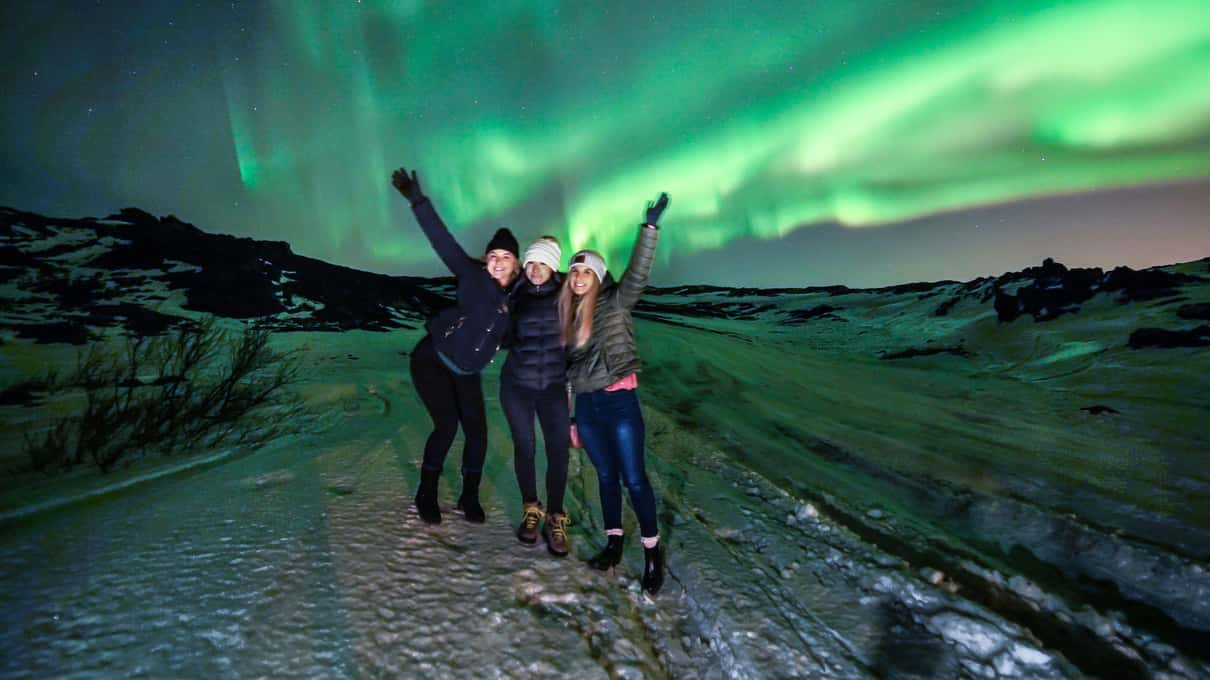
A lava cave first, then the open sky
Raufarhólshellir with a caving guide, then a minibus hunt for the lights with blankets and hot cocoa. Up to 28 guests, and the free retry covers the aurora part only.
The catch is time. With the cave first, less of the evening is left for the sky than on a pure aurora hunt. That suits families and anyone who wants a sure half to the night, as our guide to tours with children explains.
North along the coast past Esja
Across the bay from the city rises Esja, the flat-topped mountain you see from most of Reykjavík. Drivers sometimes follow the coast road north around it toward Hvalfjörður, a long fjord with dark water and steep slopes.
A mountain behind the aurora gives a photo shape and scale. The fjord shore is quiet at night, and some bends of the road have pull-outs where a minibus can stop safely.
Cloud often builds against high ground, though, so this direction works best when the forecast shows clear air from the north. A good guide drops it fast when the summits disappear.
Why the vehicle shapes the route
A coach for 60 people needs wide roads and big parking areas. Small vehicles can use narrower side roads, and the listings say so. Nordur Travel runs a modified 4x4 minibus meant to go further from city light, and Arctic Adventures says its minibus reaches spots big buses cannot.
Aurora Viking, from ~$165, keeps to 18 seats in a minibus and holds 4.9 from 590+ reviews on Viator. Nordur Travel's 4x4 tour, from ~$167, takes up to 19. Our guide to group size weighs how that changes each stop.
Price rises with the smaller vehicles, as our page on what each seat costs shows. If you have a car and want to try the dark spots yourself, read our guide to seeing the lights without a tour before you set off.