The best months for auroras near Reykjavík
Northern lights tours from Reykjavík run from about September to mid-April, when the nights are dark enough. Within that window, the weather on your dates matters more than the month. Below, what changes from autumn to spring and how to plan around it.
The dark months, roughly September to mid-April
The aurora is active all year, but you need a dark sky to see it. Near Reykjavík the nights are only long enough between roughly September and mid-April, and operators plan their season around that.
In early summer the problem is light, not cloud. Reykjavík sits a little south of the Arctic Circle, at about 64° north, so the sun does set, but from roughly mid-May into early August twilight fills the short night.
The edges of the season are soft. Late August and late April can bring a few dark hours, though the window each night is short and late.
Autumn brings clear roads and open lakes
September and October are mild by Icelandic standards. Roads are usually free of snow and lakes have not frozen yet.
The nights are already long enough for a full four-hour tour. An aurora reflected in still water is one of the pictures autumn makes possible, and the stops are less bitter than in January.
The trade is shorter darkness than in midwinter, so the guides have fewer hours to work with each night. Rain is common too, and a wet night can feel colder than a dry frost.
Midwinter and the longest nights
Around midwinter Reykjavík gets only about four to five hours of daylight. That leaves a long dark window, and the guide has more hours to look for a clear sky.
Deep winter also brings more storms. Wind-driven snow and ice close roads at times, and tours cancel when driving is unsafe. The stops are colder too, so read our clothing guide before you pack.
Snow on the ground makes a bright foreground for photos, and the air between weather fronts can be crisp and clear. Our photography guide covers shooting over snow and lava.
Spring, as the dark fades
By March the nights and days are close to even, and snow usually still lies inland. Temperatures are often milder than in January, and there is still plenty of darkness for a tour.
By mid-April the dark window has shrunk to a few late hours, and the season closes soon after. A trip in early spring gives you more chances than one at the very end.
Spring weather swings fast. A sunny afternoon can turn to sleet by evening, and the reverse is common too, so a cloudy forecast at lunch is no reason to give up on the night.
Light pollution and the city
Whatever the month, Reykjavík's streetlights wash out faint aurora. A strong display can show above the rooftops, but a weak band only stands out once you are well away from town.
That is why the tours drive out, and why the season matters less than getting somewhere dark. Our guide to where the drivers head describes the usual directions, from the lava fields to the coast.
Cloud matters more than the month
Icelandic weather is changeable and often cloudy. A clear night in October beats a cloudy one in January, so no month on the calendar is a sure thing.
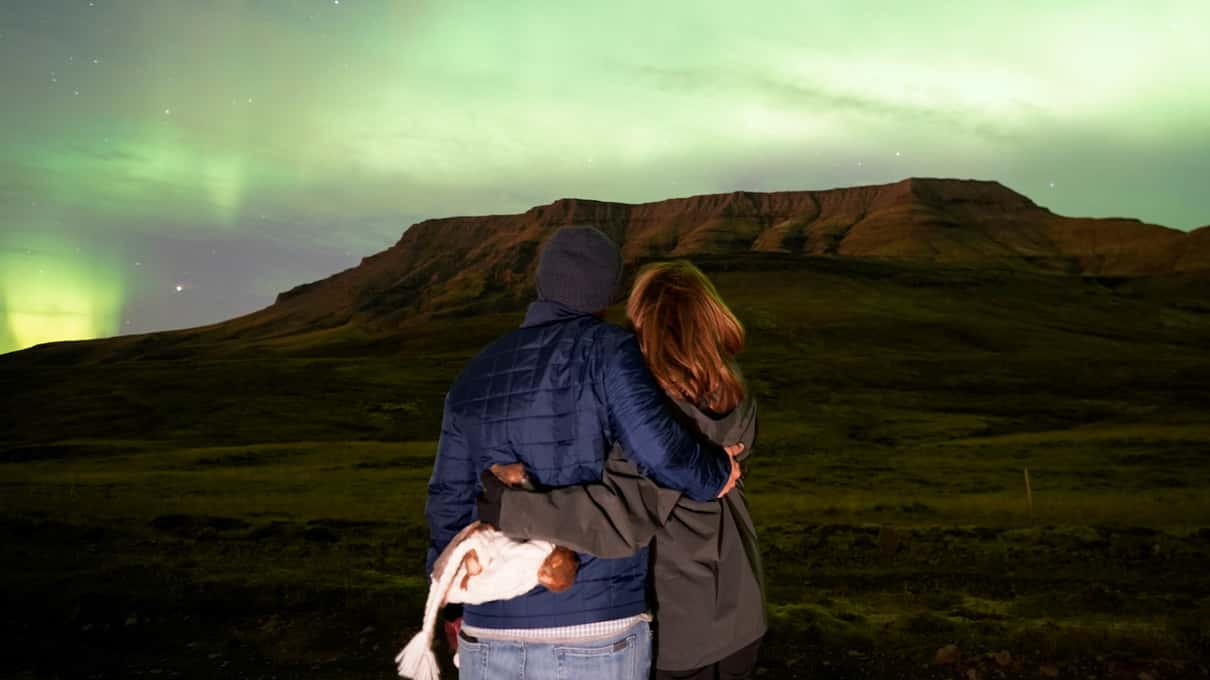
Iceland sits under the auroral oval, so on an active night a clear, dark sky often shows at least a faint band. The aurora is never guaranteed, though. A strong display can also follow a quiet week.
The Kp index describes geomagnetic activity worldwide, but local cloud decides what you see. Our guide to cloudy nights explains the two reasons a sky can stay blank.
The moon and your dates
A full moon lights up the landscape, which helps photos of mountains and lava fields. It also washes out faint aurora, so a bright moon can hide a weak band that would show on a dark night.
Around a new moon the sky is at its darkest. If your dates are flexible, a week away from the full moon gives faint lights a better chance, though a strong display shows through moonlight anyway.
A moonlit night is not a lost one. The mountains and the snow show up in photos without a long exposure, and some people prefer pictures with a lit landscape under a bright band.
Book early in your stay
Aurora Viking's minibus hunt offers unlimited free retries until you see the lights, so a first-night booking leaves the rest of your trip as backup. Four hours on GetYourGuide, up to 18 guests, with a photographer along.
How to plan the nights of your trip
The start time moves with the season, so it shows when you pick a date on the booking page. Most tours leave in the evening and come back after midnight, which makes the next morning slow.
- Book your tour for your first or second night, so a retry has room
- Stay three or four nights if seeing the aurora is a main goal of the trip
- Watch the cloud forecast, and use free cancellation up to 24 hours before if a storm is coming
- Leave an evening free near the end for a retry
Booking early matters more than picking the right month. Aurora Viking from ~$165 suits this plan best, and our price comparison sets its retry rule beside the other two.
Clear nights between tours can pay off as well. Our guide to watching on your own covers spots in and near the city.